
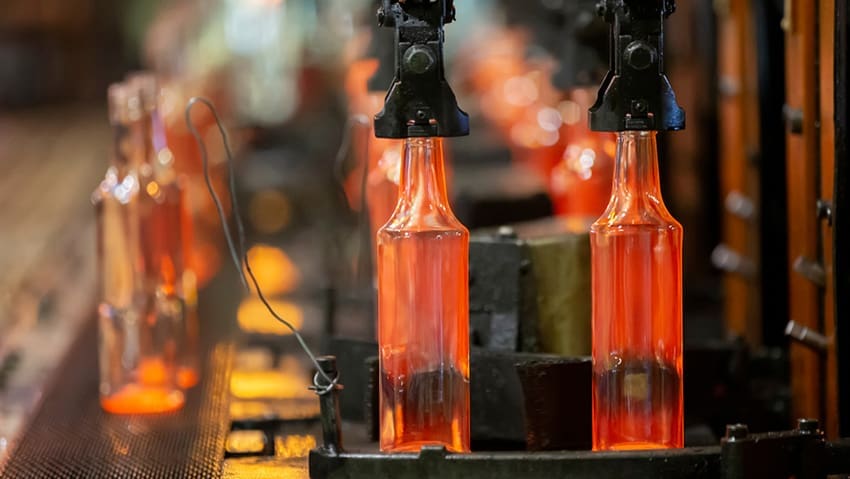
I have a friend who runs a glassworks in Yorkshire, third-generation, family-owned, the kind of business that produces, for not much money, the small clear bottles that sit on the shelves of the most exclusive perfume houses in Paris.
I rang him last week to ask how trading was. He answered the phone with a single word, which I cannot repeat in this magazine, and then explained, in a tone I have heard once or twice before in my life, that he had spent the morning working out at what point in the calendar he was going to have to extinguish his furnaces.
Extinguishing a furnace, in case you have not had cause to think about this before, is approximately the worst thing that can happen to a glassworks. Once a furnace is cold, the lining cracks; once the lining cracks, you are looking at six months of rebuild before you can produce a single bottle. It is, in industrial terms, the equivalent of a cardiac arrest. And yet several British manufacturing furnaces, in glass, in ceramics, in chemicals, in steel, have either gone cold this winter or are, on the present trajectory, going to.
The reason, in a single number, is energy. British industrial users in 2026 pay, on average, £196 per megawatt-hour for electricity. American industrial users pay around £52. French industrial users, who, for reasons the Treasury has never quite articulated, get to dip into a heavily subsidised national nuclear baseload, pay £64. Our German competitors have been forced down to about £80 by a series of emergency measures that are now, awkwardly, being extended through 2028. The British manufacturer is, as ever, the outlier.
We dress the situation up as climate leadership. We are, the Treasury insists, “front-running” the decarbonisation curve. Our prices reflect a “mature market” for renewables. The carbon-pricing mechanism “sends the right signals”. Each of these phrases has a kind of grim Civil Service music to it, and each of them is wrong. Our industrial energy prices are not high because we are decarbonising. They are high because we are decarbonising badly: with no domestic gas backbone, no serious nuclear build-out, no functioning interconnector strategy, and a wholesale market design that prices everything at the marginal gas plant even when the marginal plant isn’t running.
Each of those flaws is fixable. None of them is being fixed. The Energy Department is consumed, instead, with consumer-facing slogans about heat pumps. Heat pumps are fine. They will not, on their own or together, save my Yorkshire friend’s glassworks.
The macro picture is the part that ought to alarm Whitehall. Britain has lost about 18 per cent of its manufacturing capacity in the last six years. We have lost the third of our cement we used to make. We have lost most of our flat glass. We have lost two of our remaining four virgin steel sites. We are about to lose, by my reckoning, the bulk of our specialty chemicals. Each of these closures is announced individually, with a flurry of regret from the local MP and a politely worded statement from the trade body, and each is folded back into a national narrative about the “transition”. There is no transition. There is a substitution. We are substituting the British factory for the foreign factory.
We are also substituting the British job. The 50,000 to 60,000 manufacturing jobs lost in this Parliament are not, despite the warm words about “green retraining”, being replaced. The retraining schemes I have looked at, in detail, produce, mostly, lower-paid work in lower-skilled service sectors. The wage premium of British manufacturing, the reason a Yorkshire glassworker, on his late shift, takes home meaningfully more than the supermarket logistics worker on his, is, slowly, being smoothed away. The country is about to discover, in another decade, what every economy that has lost its industrial base discovers: that the social fabric of the place where the factory used to be does not survive the smoothing.
What would actually save the situation? A formal industrial energy price cap, indexed to French levels, paid for in the short run by an explicit ring-fenced borrowing facility, on the basis that this is what every other major Western economy has done. A long-overdue sit-down with the Office for Nuclear Regulation about the absurd timescales for British small modular reactors, where we are, somehow, behind the Romanians. A serious carbon-border adjustment that doesn’t allow Chinese steel to continue arriving, untaxed, into a country whose own steelmakers are paying every conceivable carbon premium.
And, while we are at it, a public statement from this government, and any other that may follow it, that British manufacturing is not, contra the present mood music, a regrettable hangover from the Industrial Revolution. It is, in any country with a serious view of itself, a strategic asset. Switzerland thinks so. Germany thinks so. Japan thinks so. South Korea thinks so. The fact that Britain has somehow let itself be persuaded otherwise is the policy mistake of the decade.
My Yorkshire friend, by the way, has another six weeks. After that the furnaces, in the nicest possible way, go out. He will not, when they do, blame the planet. He will blame the country.