Every August, in a marquee in the Northamptonshire village I used to live in, three retired headmistresses judge the village cake competition. It is the most ferociously contested fixture in the rural calendar, more political than a Tory leadership race and with considerably better catering.
For nine years running, the rosette went to the same entrant. Her sponges were flawless: risen like a soufflé, jam laid with a spirit level, not a crumb out of place. The rest of us produced the sort of thing that looks as though a Labrador has sat on it.
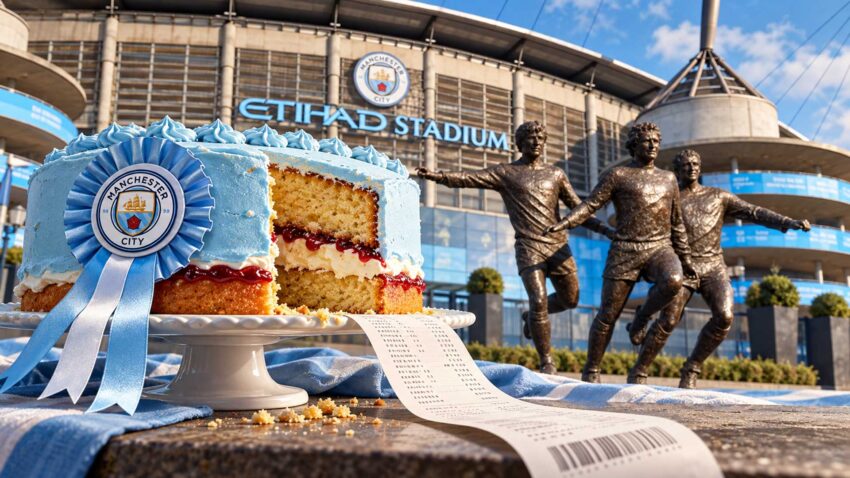
Then somebody found the Marks & Spencer receipts.
I mention this because, as a long-suffering Tottenham fan, I have spent the past week in a condition best described as vindicated grief. An independent commission has found Manchester City guilty of every serious financial charge it faced, and of most of the charges about obstructing the investigation. The Premier League’s own summary of the commission’s findings reads less like a judgment than a recipe card.
Sponsors paid only part of their fees. The rest was quietly topped up by Abu Dhabi United Group, the owner’s investment vehicle. Revenues were inflated and costs trimmed by more than £900 million across nine seasons, the accounts were misstated and the auditors kept in the dark. The sponge, in other words, came from M&S, and somebody had peeled off the label.
Meanwhile, at Tottenham, we bake from scratch. We borrowed heavily to build a stadium, paid wages with the caution of a provincial building society, and last won the league in 1961. Our cake collapses in the middle every May. One Europa League in 2025, which we still describe the way other people describe their wedding day. But it is our cake. We know where the flour came from.
City, naturally, deny everything and intend to appeal, and the sanction is yet to be decided. Their chief executive, Ferran Soriano, has told staff the entire case rests on a single false accusation: that the owner’s money was slipped in through Abu Dhabi sponsors. The defence, as reported, is that the money came from the Abu Dhabi government instead. Reports also suggest the panel did not find the owner personally aware of the schemes, which is either a comfort or a fresh worry, depending on how closely you like a shareholder to read the accounts.
Picture our champion baker before the headmistresses. “I categorically did not buy this cake from Marks & Spencer. The household did.” The household of which she happens to be deputy head.
Which brings me to the question nobody in Abu Dhabi is keen to answer. If Manchester City was bought, at least in part, as a shop window for the emirate, what does it say that the window was dressed using the emirate’s own companies?
Business readers will recognise the principle immediately. When you build your brand through a proxy, the proxy’s conduct becomes your conduct. And the entire value of a sponsorship lies in the signal it sends: that an independent company, looking at the numbers, judged you worth paying. Disguised owner money does not merely bend a rule. It destroys the signal, rather like a glowing five-star review that turns out to have been written by your mother.
That matters far beyond the Etihad, because Abu Dhabi is not only selling football. It is selling itself as a safe home for other people’s capital. Its sovereign fund Mubadala made a £10 billion commitment to British infrastructure and industry back in 2021, and Abu Dhabi money has since rescued household names, including McLaren’s loss-making automotive arm. A sovereign investor’s real currency is trust. “Misstated accounts” and “concealed from auditors” are precisely the phrases a counterparty least wants to read next to a familiar name.
I say this as somebody who has sat on both sides of plenty of investment tables. Due diligence is mostly an exercise in asking one dull question: are the numbers real? Every founder who has watched a perfectly good funding round wobble over a related-party transaction will feel a certain bitterness that it took football the best part of a decade to ask it of the richest club in the land.
There is a sting for the rest of the game, too. Cheating is a tax on everybody else’s honesty. Once one sponge turns out to be shop-bought, every good sponge is suspect. That is why the new regulator’s test on the source and sufficiency of owners’ funds is not bureaucratic fussiness. It is the receipt check English football should have been running all along.
As for the village, the M&S champion has retired. This year, I finally won the rosette with a lopsided lemon drizzle. Somebody asked to see the receipt.
Thanks, City.
Richard Alvin
Richard Alvin is a serial entrepreneur, a former advisor to the UK Government about small business and an Honorary Teaching Fellow on Business at Lancaster University. A winner of the London Chamber of Commerce Business Person of the year and Freeman of the City of London for his services to business and charity. Richard is also Group MD of Capital Business Media and SME business research company Trends Research, regarded as one of the UK's leading experts in the SME sector and an active angel investor and advisor to new start companies. Richard is also the host of Save Our Business the U.S. based business advice television show. Richard is also the founder of the CBM Foundation, Capital Business Media's charitable foundation, which gives 1% of the group's time, product and profit to charity every year.