


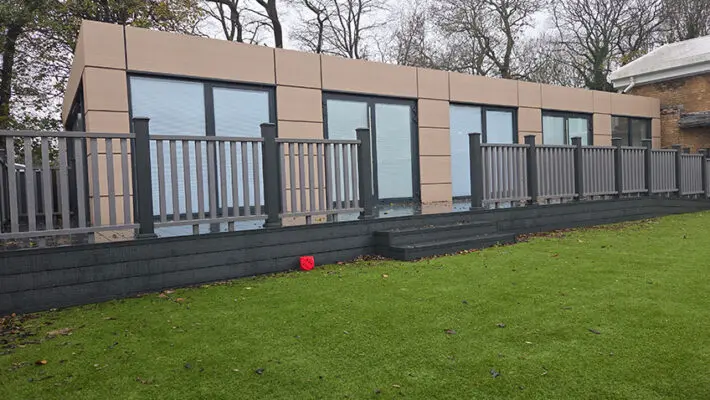
Fortunately, the construction sector has embraced a more innovative approach that answers today’s requirements perfectly – modular office buildings!
What Are Modular Office Buildings?
In the simplest terms, they are structures created from prefabricated modules. Their components are produced in factories before being transported and assembled on-site.
This makes the entire construction process more streamlined, quicker, and far less vulnerable to delays compared with conventional building methods.
Such buildings can range from small offices for start-ups to bigger corporate developments. Their key advantage is flexibility, as modules can be added, removed, or rearranged as business needs change.
This means office space can grow alongside the organisation. Moreover, modular buildings can be relocated, as they can be dismantled and reconstructed at a different location.
Why Are Traditional Offices No Longer Enough?
Traditional offices often struggle to keep pace with the changes taking place in a rapidly growing company. When employee numbers, working models, or structures can change quickly, conventional office solutions simply do not provide sufficient flexibility.
Costs are another important factor, as they are generally higher right from the start. Developing a traditional office can take many months or years, and during this time, the investment already generates costs without providing any return, because the space remains unusable.
Modular buildings are more economical (while ensuring comparable quality and durability), and the build time is considerably reduced.
Furthermore, existing (used) modules can be effectively reused, as they continue to serve their purpose well and are virtually ready for immediate occupancy.
The Main Benefits of Modular Buildings for Businesses
We have already mentioned some of the advantages above, including flexibility, affordability, and construction times. However, there are more advantages worth noting.
- Customisable design options – modular office can be customised to match a company’s visual identity, ensuring they accurately represent the organisation.
- High durability and build quality – despite being completed faster than conventional buildings, modular structures maintain excellent standards of quality and longevity. In fact, they can be used for many decades.
- Facilities and utilities – modular buildings can be fitted with all essential utilities, including water, gas, and heating systems, as well as energy-efficient solutions such as heat pumps or photovoltaic panels.
These sustainable technologies significantly lower operational costs and optimize the Total Cost of Ownership, while directly supporting corporate UK carbon reduction targets.
Will Modular Offices Transform the Workspace? Summary
Although modular solutions have not yet captured the entire market, there is no denying that they are becoming increasingly popular, so it’s reasonable to expect more companies to invest in them as the market continues to evolve.
Of course, traditional construction will remain part of the market, but in many sectors, especially those seeking greater flexibility, modular buildings may prove to be a far more convenient solution.
However, it’s important to choose a trusted supplier and manufacturer of modular units. And that is exactly what JCPSA is – a company that has been delivering modular buildings to businesses across the country for many years. Find out more here: jcpsa.co.uk.